
Understanding Wyckoff Accumulation: A Key to Successful Trading
12/24/20254 min read
What is Wyckoff Accumulation?
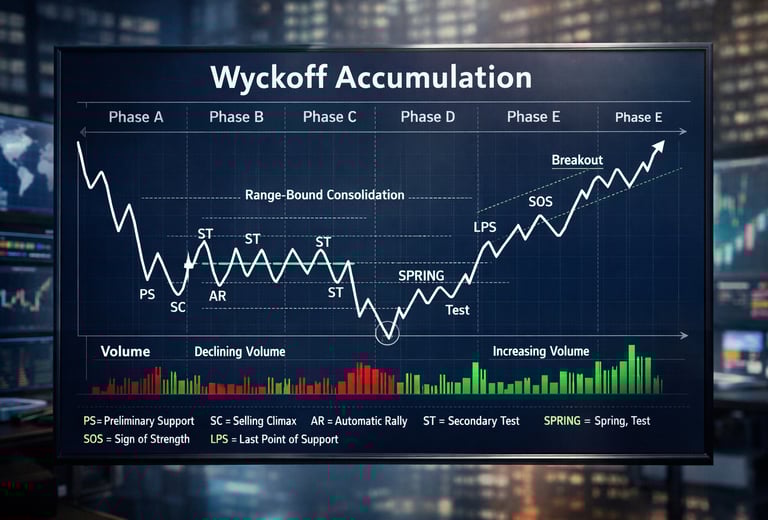
The Wyckoff Accumulation process is a trading method that originated from the work of Richard D. Wyckoff, a prominent early 20th-century stock trader. It is particularly valuable for traders seeking to comprehend market movements and identify potential bullish trends within financial charts. Wyckoff Accumulation focuses on understanding supply and demand dynamics, which are fundamental to effective trading strategies.
The accumulation phase occurs when a security undergoes a consolidation period after a downtrend, indicating that smart money or institutional investors are beginning to accumulate shares. This phase typically features a series of small price fluctuations accompanied by increasing volume, suggesting that buyers are stepping in to absorb excess supply. The overall objective during this period is to establish a strong base that can eventually lead to upward price movement.
Integral to the Wyckoff Accumulation process is the analysis of price and volume, which provides traders with critical insights into market sentiment. By closely examining volume patterns during this phase, traders can distinguish between genuine accumulation and mere price fluctuations resulting from speculative trading. For example, an increase in volume that coincides with price stability can signal an accumulation scenario, while decreasing volume during price rises may indicate a lack of commitment from the buying side.
In essence, the Wyckoff Accumulation technique enables traders to pinpoint potential entry points in the market by leveraging an in-depth understanding of price actions and volume trends. Consequently, this methodology assists in identifying when a bullish trend may be underway, thereby enhancing the likelihood of successful trades in the financial markets. By grasping the principles of Wyckoff Accumulation, traders can better navigate the complexities of market behavior and make informed decisions that align with their trading objectives.
The Phases of Wyckoff Accumulation
The Wyckoff Accumulation is composed of several distinct phases, which traders can identify on price charts to anticipate future price movements. Understanding these phases is crucial for capitalizing on trading opportunities. The primary phases include Distribution, Wicked Selling, and Reaccumulation.
The first phase, Distribution, occurs when a security has significantly risen in price. During this phase, strong hands (informed traders) sell their positions to weak hands (uninformed traders), leading to a gradual price decline. The market may exhibit signs of indecision during this phase, characterized by a series of consolidation patterns on the chart. It often features higher volume spikes that can indicate selling pressure.
Next is the Wicked Selling phase, which follows Distribution. This is where the price experiences an abrupt decline, often fueled by panic selling. Traders might notice sharp downward moves on the chart, accompanied by high volume, indicating that sellers are aggressively driving down the price. Recognizing this phase often requires vigilance, as it can be preceded by deceptive price actions that could mislead novice traders.
Finally, the Reaccumulation phase involves the price stabilizing and starting to form a base after the wicked selling. In this phase, informed traders start to accumulate positions again, leading to the potential for a new upward trend. Chart patterns like commas, flags, and pennants may emerge during this phase. Low volatility with increasing volume often indicates this accumulation phase is gaining strength.
By examining these phases on a price chart, traders can better position themselves for potential opportunities. Recognizing the nuances of each phase significantly enhances trading strategies and decision-making processes.
How to Trade Using Wyckoff Accumulation
Trading using the Wyckoff Accumulation schema requires a solid understanding of market phases and the psychology behind price movements. The Wyckoff method highlights the importance of recognizing accumulation, distribution, and market cycles, which can significantly enhance a trader's strategy.
To effectively incorporate the Wyckoff Accumulation strategy, traders should start with risk management techniques. One of the foundational principles of successful trading is to minimize potential losses. Establishing risk management protocols involves determining the maximum amount of capital a trader is willing to risk on any single trade. A common approach is to set a stop-loss order just below a defined support level, ensuring that losses are contained should the trade not go as anticipated.
When identifying entry and exit points, traders should look for signs of accumulation within price charts. By observing volume spikes in conjunction with price consolidation, traders can pinpoint optimal entry opportunities. It is also advisable to track the market's behavior post-entry. For instance, if prices move beyond resistance levels coupled with strong volume, it may signal continued bullish momentum.
Furthermore, confirming trends before executing trades is crucial. This can be achieved by utilizing technical indicators, such as moving averages or trend lines, which can provide additional validation for the direction a security is likely to take. Engaging in thorough analysis, including multiple time frame assessments, ensures a more rounded perspective on market conditions.
By following these practical tips for trading using the Wyckoff Accumulation theory, traders can better navigate the complexities of market movements, enhancing their strategies for entry, exit, and overall profitability. The key is to remain vigilant in monitoring market signals and adapting one’s approach as necessary.
Final Thoughts and Resources
Understanding the Wyckoff Accumulation strategy is crucial for traders looking to capitalize on market trends and optimize their investment strategies. This particular method provides a framework for identifying potential buying opportunities based on market phases, which can lead to more informed trading decisions. Throughout this blog post, we have explored the key components of the Wyckoff Accumulation process, including its principles and phases, while emphasizing the importance of understanding market psychology.
To effectively apply the Wyckoff Accumulation strategy, traders should focus on the various stages outlined earlier. Recognizing the signs of accumulation, such as increased volume and price stabilization, is essential for entering the market at opportune moments. As a trader, you can enhance your trading skills by continually studying these market dynamics and practicing analysis on historical data through simulations or live markets.
Moreover, continuing education is paramount in the fast-evolving world of trading. We encourage you to explore resources that provide deeper insights into financial markets and various trading strategies. For those interested in improving their financial knowledge, the GO AI-ACADEMY is an excellent platform where you can delve into comprehensive courses related to market analysis and investment strategies.
Additionally, if you are looking for a reliable platform to start your trading journey, consider using a reputable cryptocurrency exchange. You may want to explore our recommended exchange, which can be found through the following the link: OKX-EXCHANGE. By leveraging these valuable resources and implementing the Wyckoff Accumulation approach, you can enhance your trading acumen and potentially achieve better outcomes in your trading ventures.
EconoTrade Insights
Learn. Trade. Grow.
Empowering financial freedom through smart education and trusted tools.
© 2025 ECONO TRADE INSIGHTS. All rights reserved.
About - https://econotradeinsights.com/about-us-financial-blogging
Contact - econotradeinsights@gmail.com
Disclaimer - https://econotradeinsights.com/disclaimer
Terms & Conditions - https://econotradeinsights.com/terms-and-conditions