
Exploring Trading Types: A Comprehensive Guide to Financial Markets
1/11/20265 min read
Understanding Financial Markets and Trading Types
Financial markets are platforms that facilitate the exchange of financial assets, including stocks, bonds, commodities, and currencies. They play an essential role in the global economy by fostering capital formation and enabling price discovery. By bringing together buyers and sellers, financial markets provide liquidity and transparency, thus contributing to the overall stability of financial systems.
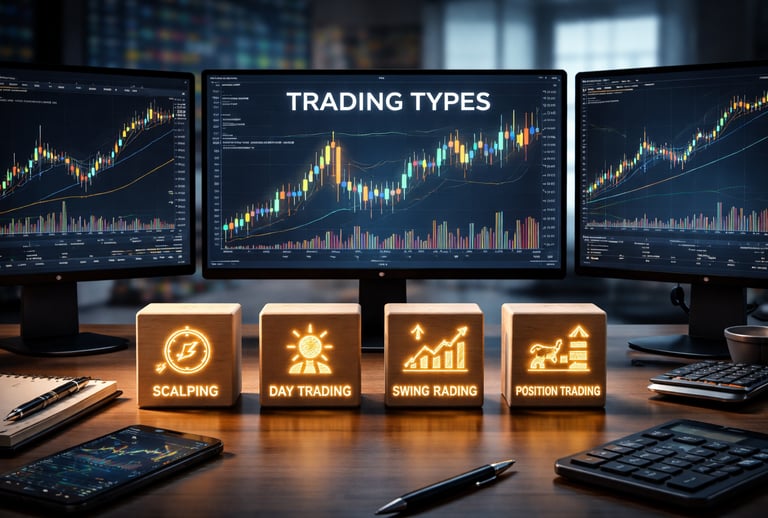
There are various types of trading options available to investors, each catering to different strategies, time horizons, and risk tolerances. Understanding these trading types is pivotal for anyone looking to participate in financial markets. Four prominent trading styles include day trading, swing trading, position trading, and scalping.
Day trading involves executing multiple trades within a single day, with traders seeking to capitalize on short-term price fluctuations. This strategy requires a keen understanding of market trends and often necessitates a significant time commitment, as positions are closed before the market closes.
Swing trading, on the other hand, is a medium-term strategy where traders hold assets for several days to weeks, intending to profit from anticipated price moves. This approach allows for a more relaxed pace compared to day trading while still requiring active market analysis.
Position trading is characterized by holding positions for an extended period, often weeks to months, based on long-term trends and fundamental analysis. This style aligns well with investors who prefer to take a less active role in managing their portfolios.
Lastly, scalping involves executing numerous quick trades to capture small price movements. Scalpers operate under the principle that even minor price changes can translate into substantial profits if leveraged effectively.
Incorporating various trading types into a portfolio can lead to enhanced diversification, helping investors mitigate risk while optimizing potential returns. By exploring these trading methods, individuals can better align their strategies with their financial goals.
Day Trading: Fast-Paced and Intense
Day trading is identified as a short-term trading strategy that involves executing trades within the same day. This method of trading attracts individuals looking to capitalize on the volatility of financial markets, often resulting in numerous trades completed before the market closes. Successfully engaging in day trading requires a combination of analytical skills, discipline, and a thorough understanding of market behavior.
The typical time frame for day trading varies, although trades are generally opened and closed within a single day. Traders may hold positions for just seconds or, in some cases, hours, but the key element is ensuring that no trade remains open overnight. Successful day traders often rely on real-time analysis, requiring them to stay alert to market movements and trends throughout the trading session.
In terms of tools and technologies, day traders utilize advanced trading platforms equipped with real-time data feeds and technical analysis capabilities. These platforms allow traders to execute orders quickly, analyze charts, and monitor market conditions. Indicators such as moving averages, support and resistance levels, and candlestick patterns are often employed to inform trading decisions.
While day trading offers potential for substantial rewards, it is essential to acknowledge its inherent risks. The fast pace of the market can lead to significant losses if trades do not go as planned. New traders should consider adopting risk management strategies, such as setting stop-loss orders or limiting the size of their trades to mitigate potential losses.
For beginners considering day trading, practical tips include developing a solid trading plan, identifying personal risk tolerance, and practicing strategies using simulated trading accounts before committing real capital. Continuous education and staying updated on market trends can also enhance a trader's potential for success in this dynamic environment.
Swing Trading: Capitalizing on Market Swings
Swing trading is a popular medium-term trading strategy aimed at capitalizing on price fluctuations in financial markets. This approach focuses on holding trades from a few days to several weeks, allowing traders to profit from both upward and downward market swings. Unlike day trading, where positions are opened and closed within the same trading day, swing trading offers the opportunity to ride out price movements over a more extended period.
To effectively engage in swing trading, identifying trends is essential. Traders often rely on technical analysis, utilizing various tools such as moving averages, trend lines, and volume indicators. By analyzing price patterns and historical data, swing traders can pinpoint potential entry and exit points, thus maximizing their profit potential. It is also crucial for swing traders to remain updated on market news and economic events that could influence stock prices, as these factors can trigger significant price movements.
Another vital aspect of swing trading is the implementation of risk management techniques, including setting stop-loss orders and take-profit strategies. A stop-loss order is designed to limit potential losses by automatically closing a position when a security reaches a predetermined price. This technique helps protect capital while allowing the trader to set realistic profit targets through take-profit orders. By effectively managing risk, swing traders can navigate market volatility and enhance their chances of financial success.
While swing trading has its advantages, such as less time commitment and reduced stress compared to day trading, it also comes with its own set of challenges. Market shifts can be unpredictable, and traders may encounter scenarios where their positions do not move in the anticipated direction, leading to potential losses. Balancing the advantages and disadvantages of swing trading is crucial for making informed trading decisions and setting realistic expectations in this dynamic market environment.
Long-Term Trading Strategies: Position Trading and Beyond
Position trading emerges as a notable long-term trading strategy, appealing to investors who prefer a more relaxed engagement with financial markets. This strategy emphasizes holding on to assets for extended periods, often ranging from several months to years. By doing so, position traders focus on the underlying fundamentals of the assets, rather than succumbing to short-term market fluctuations. Fundamental analysis plays a pivotal role in this strategy, as it helps traders identify stocks with strong growth potential based on economic indicators, company performance, and industry trends.
When selecting stocks for long-term investment within a position trading framework, it is vital to evaluate various parameters, including earnings growth, competitive advantage, and historical performance. A thorough understanding of a company's financial health can significantly impact decision-making processes. Additionally, extensive research into macroeconomic conditions is necessary to assess the viability of industries and market sectors over the long haul.
The psychological aspects of trading cannot be neglected, particularly in the context of long-term strategies. Position traders must cultivate patience and discipline, resisting the urge to react impulsively to market movements. Developing a robust trading plan that includes entry and exit points can mitigate the emotional challenges associated with long-term investing.
Diversification serves as a cornerstone of risk management in position trading. By spreading investments across various sectors and asset classes, investors can reduce exposure to potential losses from any single investment. This strategy allows for a balance between risk and return if market conditions change.
For individuals eager to enhance their trading knowledge, a wealth of resources is available at GO AI-ACADEMY. Continuing education in financial markets remains a crucial investment toward achieving long-term trading success.
EconoTrade Insights
Learn. Trade. Grow.
Empowering financial freedom through smart education and trusted tools.
© 2025 ECONO TRADE INSIGHTS. All rights reserved.
About - https://econotradeinsights.com/about-us-financial-blogging
Contact - econotradeinsights@gmail.com
Disclaimer - https://econotradeinsights.com/disclaimer
Terms & Conditions - https://econotradeinsights.com/terms-and-conditions