Understanding the Recent Collapse in Gold and Silver Prices: Profit-Taking or Economic Crisis?
2/2/20264 min read
The Current State of Gold and Silver Markets
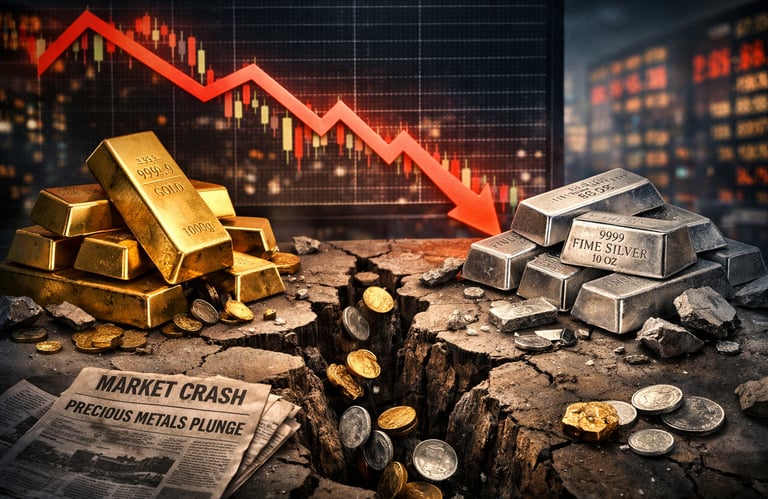
The dynamics of gold and silver markets have recently undergone significant fluctuations. Analyzing gold prices, we see that they have experienced both rapid appreciation and volatility, driven by various global economic factors. The recent downturn in gold prices has raised questions among investors regarding the sustainability of these assets as safe havens during economic uncertainty.
Historically, both gold and silver prices tend to react to inflation rates and interest rate shifts. Currently, with central banks adjusting policies to combat inflation, the impact on these commodities is profound. For instance, as interest rates rise, the opportunity cost of holding non-yielding assets like gold increases, leading to decreased demand. Conversely, geopolitical tensions often push gold prices upward, as investors seek refuge in such tangible assets. These conflicting influences can explain the recent market trends observed.
Silver, often viewed through the lens of its industrial usage as well as its investment potential, has mirrored gold's volatility but also brings its unique set of market factors into play. Issues such as supply chain disruptions and changes in industrial demand affect silver prices more acutely. Moreover, the correlation between the prices of these two commodities means that a decline in gold can also negatively impact silver, making them both vulnerable to market sentiment.
For investors assessing the state of gold and silver markets, it is crucial to remain cognizant of these interrelated variables. The shifting landscape of commodities necessitates a comprehensive understanding of both macroeconomic indicators and niche market developments. Thus, staying informed is imperative for navigating the complexities of investing in these precious metals as trends continue to evolve.
Profit-Taking: What Does It Mean for Investors?
Profit-taking refers to the practice of selling assets after they have appreciated in value, allowing investors to realize gains. This strategy is particularly common in volatile markets, where fluctuations can present opportunities for savvy investors to capitalize on rising prices. In the context of gold and silver prices, profit-taking can be a significant driver of short-term market movements. When investors observe rapid increases in precious metal values, the incentive to secure profits may outweigh the desire to hold onto these assets for potential further gains.
The psychology behind profit-taking is rooted in the fear of loss. As prices rise, the perceived risk of a correction often increases. Investors may anxiously decide to sell their holdings as a preventative measure against market downturns, aiming to lock in profits before potential price declines occur. This behavior can result in a wave of asset selloffs, further impacting gold and silver prices. If many investors choose to sell simultaneously, it can trigger market corrections, leading to significant downward pressure on asset values.
The recent declines in gold and silver prices may be indicative of such profit-taking behavior. However, it is essential to distinguish between a normal market correction—a healthy recalibration of prices following significant gains—and a more severe downturn stemming from economic concerns or systemic risks. While current price dynamics may suggest a temporary pullback due to profit-taking, macroeconomic factors, including inflation, interest rates, and geopolitical stability, will also play critical roles in shaping the future trajectory of gold and silver prices.
Signs of an Economic Crisis: Are We Seeing Red Flags?
The recent decline in gold and silver prices has raised concerns among investors and analysts alike, provoking discussions about potential signs of an economic crisis. To better understand this situation, it is crucial to examine a variety of macroeconomic trends that may serve as recession indicators. A primary focus is often directed towards key metrics such as unemployment rates, consumer confidence, and manufacturing outputs.
Unemployment rates are often viewed as an essential measure of economic health. A rising unemployment rate can point to a weakening economy and a diminished capacity for consumers to spend. When individuals are unable to find jobs, disposable income decreases, leading to reduced consumer spending, which can ultimately affect demand for precious metals such as gold and silver.
Consumer confidence is another critical factor that merits attention. A decline in consumer sentiment can be indicative of an underlying economic crisis. It reflects how optimistic households feel regarding their financial situation and the economy. If consumers begin to feel pessimistic, they may cut back on spending, further exacerbating financial instability.
Additionally, trends in manufacturing outputs can provide early signals regarding economic stability. A significant slowdown in manufacturing can reflect slowing demand and may ultimately lead to business contractions. As production decreases, so does the workforce necessary to sustain it, manifesting in higher unemployment rates, further affecting consumer confidence.
In conclusion, monitoring these recession indicators is essential for gaining insight into whether the recent fluctuations in gold and silver prices stem from legitimate profit-taking strategies or deeper economic vulnerabilities. By recognizing signs indicative of an economic crisis, investors can better navigate their financial futures amidst uncertain times.
Taking Action: How to Navigate the Current Market Conditions
The recent fluctuations in gold and silver prices present both challenges and opportunities for investors. To effectively manage these market dynamics, employing sound investment strategies is essential. One of the foremost strategies to consider is risk management. Understanding the levels of risk associated with various assets is crucial for making informed investment decisions. Establishing clear risk tolerance levels will guide investors in selecting appropriate investments and mitigating potential losses.
Diversification is another vital tool in navigating market volatility. By spreading investments across a range of asset classes, including stocks, bonds, and commodities like gold and silver, investors can reduce the impact of significant downturns in any single market. This approach helps maintain a balanced portfolio and ensures that investments remain resilient during turbulent economic periods.
Moreover, continuous financial education is a key component for any investor looking to advocate effective decision-making in unpredictable environments. Staying updated with market trends, understanding economic indicators, and learning about different investment vehicles can significantly enhance an investor’s ability to adapt to changing conditions. Online resources can offer valuable insights, and websites such as GO AI-ACADEMY provide educational materials and tools for those eager to improve their financial literacy and refine their investment strategies.
In conclusion, by incorporating risk management techniques, diversifying asset allocations, and investing in financial education, individuals can better navigate the current volatility in the gold and silver markets. These proactive measures not only safeguard investments but also empower investors to seize opportunities even amidst uncertainty.
EconoTrade Insights
Learn. Trade. Grow.
Empowering financial freedom through smart education and trusted tools.
© 2025 ECONO TRADE INSIGHTS. All rights reserved.
About - https://econotradeinsights.com/about-us-financial-blogging
Contact - econotradeinsights@gmail.com
Disclaimer - https://econotradeinsights.com/disclaimer
Terms & Conditions - https://econotradeinsights.com/terms-and-conditions