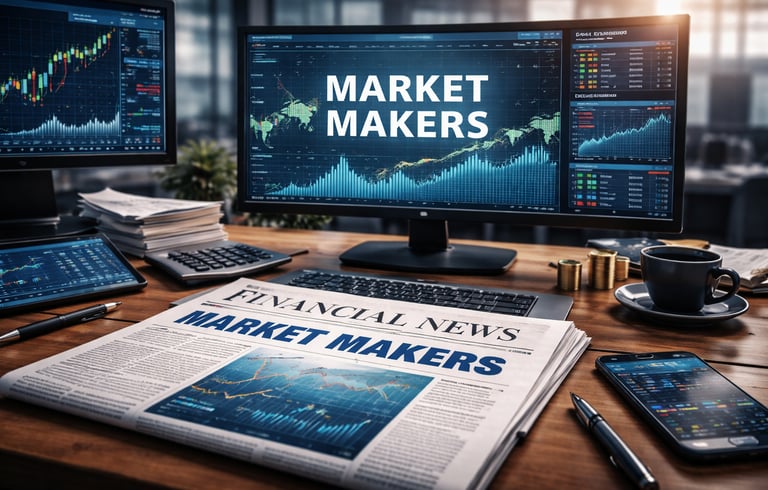
Decoding Financial News: Are Market Makers Behind the Headlines?
12/29/20254 min read
Understanding Market Makers
Market makers play a vital role in the financial ecosystem, acting as intermediaries that facilitate trading in financial markets. At its core, a market maker is a firm or individual that provides liquidity to securities by being prepared to buy and sell assets on a consistent basis. The primary function of these entities is to maintain an orderly market by ensuring that there are enough buyers and sellers at any given time. This is especially crucial in less liquid markets where trades can be infrequent and price volatility is higher.
One of the key responsibilities of market makers is to quote both buy and sell prices for a specified number of shares or contracts. By frequently updating these quotes, market makers help to establish a fair market price. This continuous buying and selling create a stable flow of transactions, which in turn boosts investor confidence and encourages further trading activity. The tight bid-ask spreads that result from market makers’ actions contribute to the overall efficiency of financial markets.
Moreover, market makers also absorb excess supply or demand, serving as a buffer during periods of market strain. For instance, when there is a surge of sell orders, market makers can step in to purchase the excess volume, preventing sharp declines in asset prices. This interaction not only fosters liquidity but also stabilizes market conditions, influencing how news is perceived and interpreted by investors. While market makers primarily focus on immediate trading conditions, their activities can inadvertently shape financial news narratives, impacting overall market sentiment and investor behavior.
The Intersection of Financial News and Market Manipulation
The relationship between financial news and market manipulation is a complex and evolving subject that warrants careful examination. Financial news serves as a critical information source for investors; however, the manipulation of this news can lead to a significant distortion in market behavior. Market makers, often intermediaries in financial transactions, have been known to influence perceptions and decisions regarding financial assets through strategic dissemination of news.
Historical incidents illustrate this dynamic. For instance, during the infamous Dot-com bubble, certain tech companies used favorable press releases to artificially inflate their stock prices, only to see these valuations plummet once the hype diminished. This manipulation often involves market makers capitalizing on the selective release of information to shape investor sentiment, thereby creating opportunities for profit at the expense of uninformed traders.
In contemporary contexts, social media has amplified the dissemination of financial news, making it easier for market makers to spread rumors or positive information about certain stocks. The phenomenon surrounding "meme stocks" in 2021 exemplifies this intersection, where coordinated efforts on platforms like Reddit resulted in extraordinary volatility, leading to questions about the integrity of information sources. Such scenarios illustrate the crucial role of financial news in forming perceptions that can be exploited by market players.
As we analyze trends in market behavior, it becomes evident that the flow of information is not simply reactive; it is often a calculated process. Articles, interviews, and releases can be timed to coincide with market events, reinforcing the idea that financial news may be weaponized for market manipulation. By understanding these interrelationships, investors can be more vigilant about the implications of the news they consume and how it may be influenced by underlying market factors.
The Impact of Financial News on Investors
Financial news plays a pivotal role in shaping the decisions and behaviors of investors. As markets are often influenced by perceptions and reactions to news, understanding its impact can help investors navigate volatility and determine informed strategies. Retail investors, in particular, may experience varying responses to market events based on the narratives presented in financial media.
Psychologically, retail investors can be particularly susceptible to sensationalized headlines. When news portrays a company or sector in a negative light, fear and panic may lead to hasty, emotionally-driven selling. Conversely, overly optimistic reports can instigate a herd mentality, prompting investors to buy indiscriminately, often disregarding fundamental analysis. This emotional decision-making can exacerbate volatility in the market, with stock prices swinging dramatically based on the latest story circulating in the media.
A pertinent illustration of financial news impact can be seen during the COVID-19 pandemic. As lockdowns commenced, companies across various industries faced uncertainty and drastic changes. Financial news sources reported on these developments, and reactions varied. For instance, stocks of travel and hospitality firms plummeted in the wake of negative reports, reflecting investors' panic. On the contrary, e-commerce and technology companies experienced surges as news highlighted their potential growth amidst the crisis. Analyzing such case studies reveals the pronounced influence that financial narratives can have on market dynamics.
To mitigate the risks associated with reacting impulsively to news, investors should adhere to best practices. This includes verifying information from multiple sources, understanding the broader context of financial news, and focusing on long-term investment strategies rather than short-term fluctuations. Developing critical thinking skills regarding news stories can greatly enhance an investor's ability to make sound decisions amidst the constant flow of financial information.
Taking Action: Your Path to Financial Literacy and Smart Investing
As the financial landscape becomes increasingly complex, enhancing your financial literacy is essential for navigating through the noise of financial news. Understanding the dynamics that influence financial markets empowers individuals to make informed decisions regarding their investments. By sharpening your knowledge in finance, you can critically assess news headlines, discern the underlying narratives, and act wisely on potential opportunities or risks.
A practical approach to elevating financial literacy is to engage with educational resources. Several online platforms offer comprehensive courses designed for varying levels of expertise. One such resource is GO AI-ACADEMY, featuring courses that range from basic financial concepts to advanced investment strategies. This platform ensures that learners can progressively build their understanding of the markets, fostering well-informed decision-making.
Additionally, keeping abreast of financial news from reputable sources is crucial. Establishing a habit of reviewing market analysis and expert opinions can grant deeper insight into the ramifications of recent events. Consider subscribing to financial newsletters or joining discussions in financial forums, which can provide diverse perspectives on current market conditions. Engaging in community discussions around investing can further enhance your knowledge base.
When looking to invest, it is critical to utilize a trusted platform that offers secure trading options. We recommend using OKX-EXCHANGE to kickstart your investing journey. Engaging with a reliable exchange allows you to trade with confidence while also providing educational resources and tools to assist your understanding of the crypto space. By taking these steps towards improving your financial literacy and actively participating in the investment community, you will be better equipped to navigate financial news effectively and make sound investment choices.
EconoTrade Insights
Learn. Trade. Grow.
Empowering financial freedom through smart education and trusted tools.
© 2025 ECONO TRADE INSIGHTS. All rights reserved.
About - https://econotradeinsights.com/about-us-financial-blogging
Contact - econotradeinsights@gmail.com
Disclaimer - https://econotradeinsights.com/disclaimer
Terms & Conditions - https://econotradeinsights.com/terms-and-conditions