Transitioning from Quantitative Tightening (QT) to Quantitative Easing (QE): Effects on Financial Markets
1/3/20264 min read
Understanding QT and QE: Definitions and Key Differences
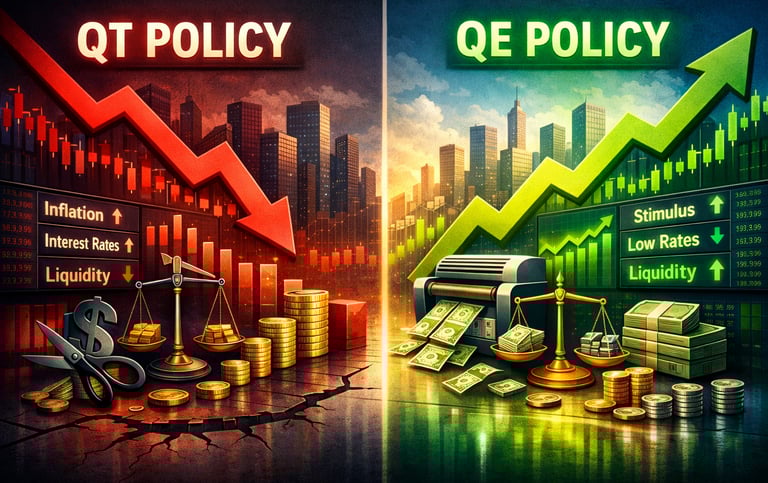
Quantitative Tightening (QT) and Quantitative Easing (QE) are two opposing monetary policies employed by central banks to influence economic conditions. QT refers to the process where a central bank reduces the amount of money circulating in the economy. This typically involves selling government securities or allowing them to mature without reinvestment, thereby effectively tightening the monetary supply. The objective of QT is generally to combat inflationary pressures and stabilize an overheating economy.
On the contrary, QE is a monetary policy used primarily in times of economic decline or recession, where the central bank increases the money supply to stimulate economic activity. Through the purchase of government and possibly other types of securities, the central bank injects liquidity into the financial markets. This strategy aims to lower interest rates, encourage borrowing, increase consumer spending, and ultimately drive economic growth.
The key differences between QT and QE extend beyond their definitions. While QT is concerned with reducing liquidity to prevent excessive growth in asset prices and inflation, QE seeks to promote liquidity to encourage investment and consumption. The implications of each policy on interest rates are also noteworthy; QT typically leads to higher interest rates as the supply of money decreases, while QE generally results in lower interest rates due to increased money supply.
In terms of asset prices, QT can lead to declines as investors adjust to higher interest rates and diminished liquidity, while QE often supports rising asset prices by making borrowing cheaper. Moreover, both policies have significant effects on market liquidity, with QT tending to constrict it, whereas QE enhances market liquidity, facilitating easier access to funds for investors and institutions.
Market Reactions to Transitioning from QT to QE
The financial markets exhibit notable reactions during the transition from Quantitative Tightening (QT) to Quantitative Easing (QE). This shift significantly influences investor sentiment, stock market performance, bond yields, and cryptocurrency valuations. As central banks pivot from tightening to easing monetary policies, market participants often react quickly to anticipated changes in liquidity and economic outlook.
One immediate effect on stock markets is typically characterized by a rally in equity prices. A transition to QE usually signals that the central bank aims to stimulate economic growth by increasing the supply of money. This leads to improved investor confidence, which often results in higher stock valuations. Historical instances, such as the Federal Reserve’s transition in 2008 during the financial crisis, demonstrated a sharp increase in stock prices post-announcement of QE measures.
In parallel, bond yields tend to decrease during the conversion from QT to QE. As the central bank purchases bonds, it creates upward pressure on bond prices, leading to lower yields. Investors seeking fixed-income options often adjust their portfolios, which can result in lower interest rates across the board. This dynamic supports borrowing and spending, further aiding economic recovery. An illustrative case is the abrupt policy shift by the European Central Bank in 2015, wherein bond yields fell significantly amid extensive asset purchase programs.
Moreover, the cryptocurrency market typically experiences heightened volatility during such transitions. As traditional markets react, cryptocurrencies often reflect this sentiment, influenced by fluctuating risk appetites among investors. The anticipation of QE can lead to increased trading volumes as participants speculate on the potential for inflation and currency devaluation, thereby impacting crypto prices. Historically, notable spikes in cryptocurrency values have followed major QE announcements, driven by optimism surrounding increased liquidity.
Overall, the transition from QT to QE creates a complex interplay of market reactions, shaped by investor sentiment, volatility, and historical precursors that impact trading behavior across various asset classes.
Implications for Investors and Traders
The transition from Quantitative Tightening (QT) to Quantitative Easing (QE) holds substantial implications for various types of investors and traders. Understanding these implications is crucial for optimizing portfolio strategies and navigating the evolving financial landscape effectively.
Long-term investors may benefit significantly from QE policies, as central banks inject liquidity into the market, potentially driving up asset prices. This environment often favors equity investments, particularly in sectors such as technology and consumer discretionary, which historically have gained from low borrowing costs and increased consumer spending. Adjusting a portfolio to include growth-oriented stocks could be a viable strategy, considering that these sectors might outperform during periods of accommodative monetary policy.
Conversely, short-term traders should be attuned to the volatility that may accompany the transition. QE may lead to increased market fluctuations as traders react to policy announcements and economic indicators. Strategies involving options and futures can provide opportunities to capitalize on quick price movements. It is imperative for these traders to remain vigilant, employing risk management techniques such as stop-loss orders to mitigate potential losses.
Additionally, sector beneficiaries of QE often include real estate and utilities, sectors that typically thrive in low-interest-rate environments. Investors might consider reallocating funds towards Real Estate Investment Trusts (REITs) or utility companies to harness the potential upside of falling interest rates. However, staying updated on the macroeconomic factors influencing these sectors is essential.
Despite potential benefits, the transition to QE also carries inherent risks. Inflationary pressures could rise as increased money supply boosts demand. Therefore, investors should adopt a balanced approach, diversifying their portfolios to hedge against inflation while remaining opportunistic in rising growth sectors. In conclusion, by leveraging actionable strategies tailored to the current economic climate, both long-term and short-term investors can navigate the transition effectively and optimize their investment outcomes.
Getting Educated and Involved in Financial Markets: Recommended Resources
The transition from Quantitative Tightening (QT) to Quantitative Easing (QE) highlights the necessity for individuals and investors to stay informed and educated about shifts in financial policy. Continuous learning is essential in adapting to the dynamics of financial markets, especially during such pivotal transitions. Investors should seek out reliable educational platforms that offer a wealth of knowledge, ranging from basic principles to advanced strategies.
One trusted resource for financial education is GO AI-ACADEMY. This platform provides in-depth courses covering various aspects of financial markets, including market analysis, investment strategies, and the impacts of monetary policy changes. Engaging with these resources allows individuals to cultivate a deeper understanding of the financial mechanisms at play and to make informed decisions that align with their investment goals.
Moreover, as financial markets evolve, including the rise of digital currencies, it is also crucial to explore cryptocurrency trading. Engaging in cryptocurrency presents new opportunities amid shifting monetary policies. A reliable crypto exchange, such as OKX-EXCHANGE, can facilitate seamless trading experiences. It is imperative for prospective investors to familiarize themselves with the functionalities of such platforms, ensuring they are equipped to navigate the unique challenges and opportunities accompanying digital assets.
In light of these developments, the encouragement for continuous education and involvement in the markets remains paramount. By prioritizing learning and utilizing accessible resources, investors can enhance their ability to respond effectively to the changing financial landscape during periods of policy transition.
EconoTrade Insights
Learn. Trade. Grow.
Empowering financial freedom through smart education and trusted tools.
© 2025 ECONO TRADE INSIGHTS. All rights reserved.
About - https://econotradeinsights.com/about-us-financial-blogging
Contact - econotradeinsights@gmail.com
Disclaimer - https://econotradeinsights.com/disclaimer
Terms & Conditions - https://econotradeinsights.com/terms-and-conditions