Mastering Financial Markets: A Comprehensive Guide to Analyzing Trends and Making Informed Decisions
12/5/20254 min read
Understanding Financial Market Analysis
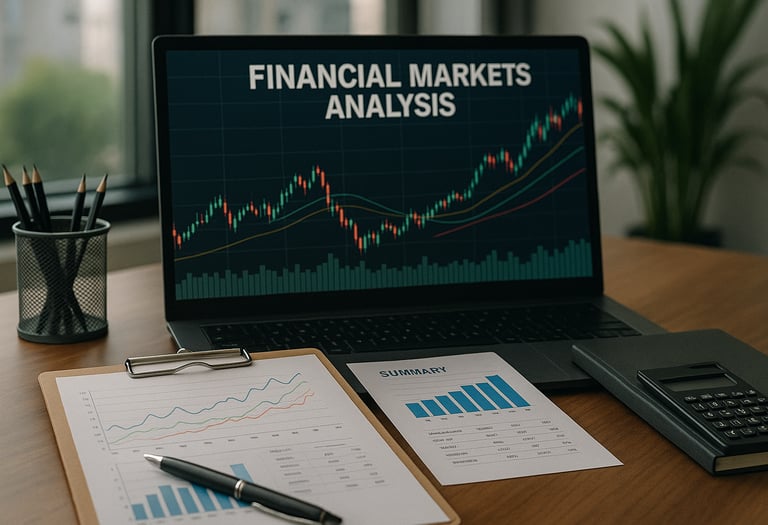
Financial market analysis is essential for investors seeking to navigate the complexities of investing effectively. Financial markets can be broadly defined as platforms where assets such as stocks, bonds, currencies, and commodities are traded. These markets facilitate the buying and selling of securities, allowing investors to exchange capital based on varying market conditions. Understanding the dynamics of these markets is pivotal for achieving financial literacy and enhancing investment strategies.
There are two primary methods of analysis employed in financial markets: fundamental analysis and technical analysis. Fundamental analysis involves evaluating a company's financial health, examining factors such as earnings reports, economic indicators, and industry trends. By assessing these elements, investors can gauge the intrinsic value of an asset and determine whether it is under or overvalued. On the other hand, technical analysis focuses on historical price movements and volume patterns to predict future price behavior. This method utilizes charts and indicators to identify market trends that may inform potential entry and exit points for traders.
The importance of financial market analysis cannot be overstated, as it enables investors to make informed decisions based on solid data rather than speculation. A thorough understanding of market trends, combined with the appropriate analytical tools, can empower investors to develop cohesive investment strategies tailored to current market conditions. Moreover, engaging in continuous education about financial markets and remaining abreast of evolving trends is fundamental for long-term success.
To cultivate a deeper understanding of financial market analysis, it is recommended that readers participate in quality educational resources that can further enhance their knowledge. For those interested in broadening their skill set, signing up for programs offered through reputable sources such as GO AI-ACADEMY can be a beneficial step towards mastering financial markets.
Key Tools and Indicators for Analyzing Financial Markets
Effective analysis of financial markets relies heavily on a variety of tools and indicators that help traders make informed decisions. Among these, price charts serve as fundamental instruments, allowing participants to visualize historical price movements and identify patterns. Recognizing price trends is crucial for both novice and seasoned traders as it aids in understanding market behavior and predicting future movements.
Another vital tool is the moving average, which smooths out price data to identify the direction of trends over specific time frames. This indicator is particularly useful in determining support and resistance levels. Traders often utilize the simple moving average (SMA) and the exponential moving average (EMA) to evaluate momentum and potential market reversals. Such technical analysis indicators provide valuable insights that assist traders in making timely decisions, whether in cryptocurrency or traditional markets.
The relative strength index (RSI) is yet another indispensable indicator in the financial toolbox. This momentum oscillator evaluates the speed and change of price movements, offering insights into overbought or oversold conditions. The RSI ranges from 0 to 100, where values above 70 typically indicate overbought conditions, while those below 30 suggest oversold status. By integrating RSI data alongside other indicators, traders can better gauge market sentiment and adjust their strategies accordingly.
Moreover, understanding market sentiment analysis enhances the overall assessment of potential trades. It involves gauging how other market participants are feeling and responding to various events, which can significantly influence asset prices. Incorporating these tools into a trading strategy fosters a more robust approach to financial market analysis. As readers explore these vital techniques, they are encouraged to put their knowledge into action. For those ready to trade, OKX-Review-Page is a reliable platform to consider for executing trades professionally.
Developing an Effective Trading Strategy
Creating a robust trading strategy is essential for navigating the complex landscape of financial markets. A well-structured approach not only includes risk management techniques but also emphasizes capital allocation and the alignment of personal investment goals with prevailing market trends. The first step toward an effective strategy is to establish clear risk management techniques that will protect your capital. This involves determining the percentage of your portfolio you are willing to risk on any single trade, often recommended to be no more than 1-2% of your total equity. Implementing stop-loss orders is a practical tactic within these techniques, as it helps mitigate potential losses and safeguards your investments.
Next, portfolio diversification plays a crucial role in spreading risk across various assets. By investing in different securities or sectors, traders can minimize the impact of one underperforming asset on their overall portfolio. It is important to continually assess correlations among your holdings to avoid concentrated risks. Furthermore, aligning trading strategies with individual investment goals entails evaluating your time horizon, knowledge, and comfort level with long-term vs. short-term trading strategies. Short-term trading often requires more frequent monitoring and analysis than long-term strategies, which may be more suitable for those pursuing gradual growth and lower stress.
To enhance your understanding of financial markets and trading techniques, consider utilizing educational platforms that provide resources and training. Online Academies such as GO AI-ACADEMY offer valuable courses that can help refine your trading approach and broaden your knowledge base. By strategically developing your trading strategy and embracing continuous learning, you position yourself to make well-informed financial decisions that align with your objectives in the market.
Staying Informed and Continuing Education in Financial Markets
In the ever-evolving world of financial markets, the necessity of continuous education and staying updated on market news cannot be overstated. Successful traders and investors recognize that possessing the latest knowledge on market trends and economic indicators is paramount for making informed decisions. Regular engagement with market news analysis equips individuals with valuable insights that can directly impact their trading strategies and investment choices.
The realms of financial markets are characterized by rapid changes, where new trends emerge almost daily. Consequently, keeping abreast of developments such as economic reports, corporate earnings announcements, and geopolitical events is essential. These factors often trigger market fluctuations and can influence investment performance. Moreover, the ability to interpret and analyze this information enhances one’s competency in detecting profitable opportunities and risks in the market.
To foster a deeper understanding of financial instruments and their interdependencies, it is advisable for individuals to utilize financial education resources. Various programs and courses are available, ranging from introductory material for novices to advanced techniques for seasoned traders. Engaging in such educational platforms not only sharpens analytical skills but also builds the confidence needed to navigate complex market scenarios.
Additionally, continuing education should be complemented by active participation in trading. Utilizing reputable exchanges, such as OKX-Review-Page, allows individuals to apply theoretical knowledge in real-world situations. Moreover, resources from platforms like GO AI-ACADEMY offer up-to-date market analysis, providing users with the required tools to stay informed.
In conclusion, the dynamic nature of financial markets underscores the importance of continuous learning and market awareness. By dedicating time to education and remaining engaged with market news, individuals can enhance their expertise and make better-informed decisions, ultimately leading to more successful outcomes in their trading endeavors.
EconoTrade Insights
Learn. Trade. Grow.
Empowering financial freedom through smart education and trusted tools.
© 2025 ECONO TRADE INSIGHTS. All rights reserved.
About - https://econotradeinsights.com/about-us-financial-blogging
Contact - econotradeinsights@gmail.com
Disclaimer - https://econotradeinsights.com/disclaimer
Terms & Conditions - https://econotradeinsights.com/terms-and-conditions