
Buying the Fear and Selling the Greed: Is This the Right Strategy for Financial Markets?
12/31/20254 min read

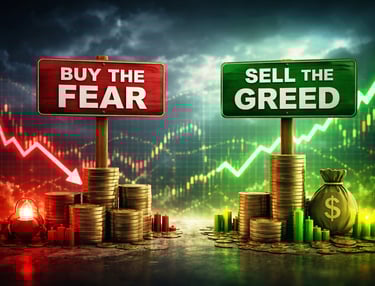
Understanding Market Psychology: Fear and Greed
Market psychology plays a crucial role in the behavior of investors, profoundly influencing their financial decisions. Two primary emotions that dominate this psychological landscape are fear and greed. Fear often emerges during market downturns or economic uncertainty, prompting investors to behave irrationally. They may panic-sell their assets, leading to a rapid decline in prices. This phenomenon illustrates the fundamental concept of herd behavior; when a significant number of investors act out of fear, they invariably contribute to a market crash, creating a cycle of negativity.
On the contrary, greed tends to manifest during bull markets characterized by rising equity values. Under these conditions, investors may become excessively optimistic, leading them to adopt a buy-at-all-costs mentality. This irrational exuberance can drive asset valuations to unsustainable levels, sometimes detaching prices from underlying fundamental values. Not historically limited to stock markets, these emotional drivers can also influence real estate, cryptocurrencies, and various financial instruments.
Real-world scenarios illustrate these concepts vividly. For example, during the financial crisis of 2008, widespread fear led to massive sell-offs, plummeting the stock market and eroding investor confidence. Conversely, the dot-com bubble of the late 1990s exemplifies greed, where investors poured money into technology stocks based on hype rather than sustainable business metrics, eventually resulting in significant losses when the bubble burst.
Psychological theories such as Prospect Theory further bolster our understanding of how fear and greed operate within the financial markets. This theory suggests that individuals are more likely to experience a higher emotional reaction to losses than equivalent gains, illustrating why fear can disproportionately affect investor psychology. By examining these emotions, investors can better navigate market fluctuations and make informed decisions that are less influenced by irrational fears or excessive greed.
Analyzing the Strategy: Buying Fear and Selling Greed
The investment strategy of buying during periods of market downturns, characterized by fear, and selling during times of market exuberance, driven by greed, has gained traction among investors seeking to capitalize on market inefficiencies. Historical case studies demonstrate that this counter-trend investing approach can yield substantial rewards. Notable examples include the significant market recoveries following the 2008 financial crisis and the sharp rebounds observed after the COVID-19 pandemic-induced market crash. In both instances, investors who strategically acquired undervalued assets during fearful market phases were able to realize considerable gains when market conditions improved.
However, while the philosophy of buying fear and selling greed is compelling, it is essential to recognize the inherent risks involved. Timing the market accurately can prove challenging, as fear often leads to further declines in asset prices, and the winds of greed may take longer to shift toward bearish sentiments. The unpredictable nature of market psychology can create detrimental outcomes for those unprepared for the potential volatility associated with counter-cyclical investing.
To mitigate risks associated with this strategy, principles such as dollar-cost averaging can be highly beneficial. By methodically investing a fixed amount at regular intervals, investors can reduce the impact of volatility and avoid the pitfalls of emotional decision-making. Moreover, adhering to a disciplined investment approach is crucial in maintaining focus on long-term financial objectives rather than being swayed by transient market conditions.
In conclusion, the strategy of buying during periods of fear and selling in times of greed can be a powerful tool in an investor’s arsenal. Understanding the historical context, recognizing the risks, and implementing sound investment tactics can align this strategy with sustainable, long-term financial goals.
Practical Tips for Implementing This Strategy
Implementing the strategy of buying fear and selling greed requires a disciplined approach intertwined with practical steps. One of the first actions investors should take is to set clear investment goals. Establishing specific, measurable, attainable, relevant, and time-bound (SMART) goals can significantly enhance decision-making processes during volatile market conditions. By knowing what to aim for, investors can mitigate impulsive reactions driven by market emotions.
Diversification is another essential principle that helps in implementing this strategy effectively. Spreading investments across various asset classes, sectors, or geographic regions can reduce risk exposure and cushion against market downturns. In times of fear, whereby many assets might decline together, diversification permits investors to remain steady, concentrating efforts on undervalued assets that have potential for growth.
Utilizing risk management tools, such as stop-loss orders, also plays a vital role in safeguarding investments. Setting a predetermined level at which to sell an asset can prevent losses from mounting during adverse market conditions, allowing investors to adhere to the strategy of buying when prices are low and selling when they are high. These automated measures enable a more rational response to market volatility, curtailing emotional reactions.
Continual education is another cornerstone of this strategy. Investors should regularly engage with market analyses, comprehend the underlying factors driving stock movements, and stay informed about economic indicators. This commitment to learning can enable investors to distinguish between rational investment opportunities and mere market noise.
Finally, employing a reflective practice post-trade can also reinforce a rational decision-making process. Documenting trades and examining the motivations behind them helps identify patterns and refine strategies over time, promoting a stronger discipline in the face of fear and greed.
Resources for Further Learning and Investment
Understanding financial markets requires a commitment to continuous education, especially considering their complexity and fluid nature. To navigate this landscape effectively, it is vital to utilize quality resources that can enhance one's knowledge and capability in trading. One highly recommended platform for comprehensive financial education is GO AI-ACADEMY. This educational hub offers an array of courses tailored to various aspects of finance, from foundational concepts to advanced trading strategies. Through interactive lessons and expert insights, users can deepen their understanding of market behavior and refine their investment techniques.
In addition to educational resources, practical experience plays an integral role in mastering financial markets. OKX is a reliable cryptocurrency exchange that provides an excellent platform for investors looking to engage with digital assets. By offering a user-friendly interface and a range of trading options, OKX allows individuals to apply their learning from educational resources in a real-world context. Engaging with the exchange can also help traders grasp the nuances of market fluctuations and develop their strategic responses more effectively.
Furthermore, utilizing these resources can support traders in adopting the mindset of buying fear and selling greed. By cultivating a thorough understanding of market psychology and behavior, investors can make more informed decisions, which ultimately contributes to long-term success in the financial markets. A proactive approach to learning and engagement with reliable trading platforms can foster better investing habits, empowering individuals to navigate the complexities of the market with confidence.
EconoTrade Insights
Learn. Trade. Grow.
Empowering financial freedom through smart education and trusted tools.
© 2025 ECONO TRADE INSIGHTS. All rights reserved.
About - https://econotradeinsights.com/about-us-financial-blogging
Contact - econotradeinsights@gmail.com
Disclaimer - https://econotradeinsights.com/disclaimer
Terms & Conditions - https://econotradeinsights.com/terms-and-conditions