
Understanding Japan's Upcoming Interest Rate Hike: Opportunities in Financial Markets
12/16/20258 min read
Introduction to Japan's Interest Rate Hike
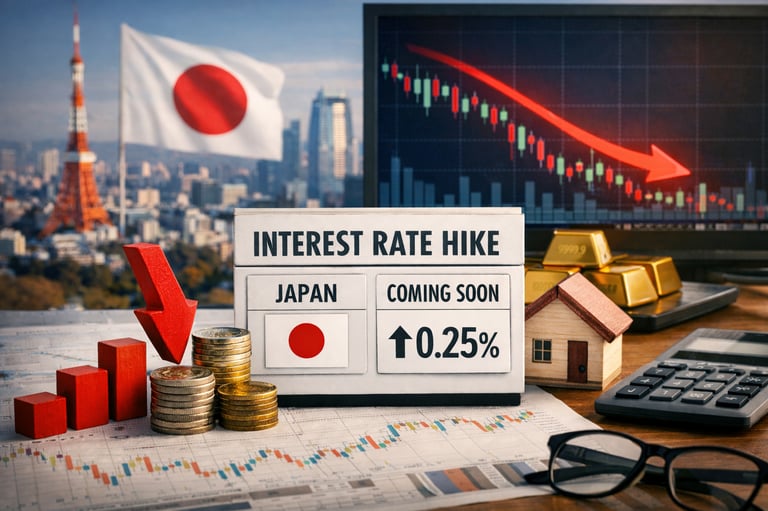
Japan is preparing to implement an interest rate hike, a significant shift in its monetary policy that could influence both domestic and international financial markets. This decision comes in response to mounting inflationary pressures, stemming from various global economic factors and domestic recovery trends. Traditionally, Japan has maintained a low-interest environment, aimed at stimulating spending and investment. However, recent data has prompted discussions on potentially altering this stance.
Recent economic indicators suggest a gradual but persistent recovery in Japan’s economy. For instance, the latest reports indicate a rise in consumer prices, which has been attributed to increased demand as the country emerges from the pandemic's economic restrictions. Inflation rates have climbed to levels not experienced in decades, leading the Bank of Japan (BOJ) to consider recalibrating its policies. This shift is significant, as rising inflation typically prompts central banks worldwide to increase interest rates as a means of controlling economic overheating.
The Bank of Japan has announced its intention to reassess its current posture, hinting at a potential hike in interest rates. Analysts suggest that this move is primarily aimed at stabilizing prices and managing inflationary expectations effectively. Such a change would not only signify a departure from years of ultralow rates but also reflect a more proactive approach to balancing economic growth and price stability.
In the context of a global economy still grappling with supply chain disruptions and varying recovery paces, Japan's decision could signal broader implications for international finance. Investors and market participants are closely monitoring these developments, as an increase in Japan's interest rates could influence currency valuations, capital flows, and investment strategies around the globe.
The Economic Implications of an Interest Rate Hike
An interest rate hike signifies a pivotal shift in monetary policy, often employed by central banks to curb inflation and stabilize the economy. The correlation between interest rates and economic growth is particularly significant. When rates rise, borrowing costs typically increase, leading to a decrease in consumer spending and corporate investments. For consumers, higher interest rates translate to increased expenses on loans and mortgages, which can restrain discretionary spending. A reduction in consumer spending can, in turn, slow economic growth as businesses experience lower demand for their products and services.
On the corporate front, companies often rely on credit to finance expansion and operational activities. When interest rates increase, the cost of borrowing rises. This situation can lead firms to postpone capital investment projects or seek alternative financing options. As a result, the overall level of corporate investment may decline, impacting job creation and the economy's long-term growth potential. In contrast, companies with stable cash flows may opt to use retained earnings rather than incurring debt, which mitigates the effect of rising rates, yet limits broader economic growth.
Foreign investments are also heavily influenced by interest rate fluctuations. Higher interest rates can attract foreign capital as investors seek better returns on their investments. This influx of capital can lead to an appreciation of the local currency, affecting exporters by making their goods more expensive in international markets. Additionally, foreign entities eyeing investment opportunities within Japan may reevaluate their strategies in light of changing interest rates and potential changes in the economic landscape. Thus, an interest rate hike can have cascading effects across multiple sectors, prompting businesses and consumers to adjust their strategies accordingly while serving as a foundational method for central banks to manage inflation and economic stability effectively.
Impact on Financial Markets: Stocks vs. Bonds
The anticipated interest rate hike in Japan is set to have significant implications for both stock and bond markets, presenting unique challenges and opportunities for investors. In the stock market, rising interest rates often lead to increased borrowing costs for companies, which can pressure profitability. As a result, sectors that typically rely on consumer spending, such as retail and discretionary goods, may experience heightened volatility. Conversely, sectors such as financials might benefit from higher interest rates, as banks and financial institutions can charge more for loans, potentially enhancing their margins and earnings. Investors should closely monitor sector performance and reallocate their portfolios accordingly to capitalize on these shifts.
Moreover, interest rate hikes can induce fluctuations in investor sentiment, leading to a sell-off in equities as market participants adjust their expectations for growth and returns. As stocks become less attractive relative to fixed-income investments, capital may flow out of the equity markets. This situation is particularly pertinent for growth stocks that have thrived in a low-rate environment, as their valuations are typically sensitive to changes in interest rates. Therefore, it is crucial for investors to assess the potential for volatility and position themselves effectively within the stock market.
On the bond side, rising rates generally lead to a decline in bond prices. When interest rates increase, newly issued bonds tend to offer better yields, making existing bonds with lower interest rates less attractive. This dynamic results in downward pressure on the prices of previously issued bonds. However, it is essential for investors to consider the nuances of the bond market, as certain types of bonds, such as inflation-linked securities or longer-duration bonds, may respond differently to the upcoming rate changes. Understanding these market reactions will allow investors to devise strategies that can mitigate risks while optimizing returns during this period of uncertain interest rate adjustments.
Understanding Currency Fluctuations in Response to Rate Hikes
Interest rate hikes play a significant role in determining the strength of a nation's currency. When a central bank, such as the Bank of Japan, increases interest rates, it typically leads to an appreciation of the currency. This is primarily because higher interest rates provide higher returns on investments denominated in that currency, attracting foreign capital inflows. As demand for the Japanese Yen increases due to these inflows, its value rises relative to other currencies. This scenario can benefit not only local investors but also foreign investors seeking to capitalize on Japan's economic potential.
Conversely, a drop in interest rates often leads to currency depreciation. Lower interest rates make monetary assets less attractive, prompting investors to move their capital to countries offering higher returns. This can result in a decrease in demand for the Yen, causing its value to weaken in global markets. Understanding these dynamics is crucial for investors, as changes in monetary policy can create significant opportunities within financial markets, particularly in the forex trading space.
Moreover, currency fluctuations due to interest rate changes have implications for international trade. A stronger Yen can make Japanese exports more expensive, potentially reducing demand from foreign buyers. On the other hand, a weaker Yen would enhance the competitiveness of Japanese goods abroad, possibly boosting export volumes. For forex traders, these fluctuations present opportunities to profit from exchange rate variations. By closely monitoring interest rate announcements and the accompanying market reactions, traders can position themselves strategically to capitalize on the resultant movements in currency pairs.
In summary, understanding how interest rate changes influence currency fluctuations is vital for investors engaged in forex trading and international markets. The interplay of interest rates, currency values, and global trade is an essential aspect to consider in the context of Japan's upcoming interest rate hike.
Cryptocurrency Market's Reaction to Economic Changes
The cryptocurrency market has often exhibited volatile reactions to shifts in traditional financial systems, particularly regarding interest rate hikes. Historically, when central banks increase interest rates, it can lead to a tightening of liquidity in financial markets. This shift often triggers a wave of investor sentiment that can either negatively or positively affect cryptocurrency prices. For instance, during previous rate hikes, investors have frequently sought refuge in non-traditional assets like Bitcoin and Ethereum, viewing them as a hedge against inflation and currency devaluation.
Recent trends provide further context regarding the interplay between interest rates and cryptocurrency valuations. As traditional markets react to monetary policy changes, cryptocurrencies have shown a tendency to decouple from traditional assets, creating unique investment opportunities. Notably, prior interest rate increases have resulted in major fluctuations in crypto prices, highlighting its speculative nature and appeal to investors seeking high returns. These fluctuations offer unique trading opportunities for seasoned investors and those considering entry into the crypto market.
Currently, many analysts believe that the anticipated interest rate hike could present a favorable entry point for potential investors in the cryptocurrency market. As traditional markets reassess their risk profiles in response to higher borrowing costs, cryptocurrencies may emerge as alternative investments, potentially increasing their market capitalizations. If this pattern continues, it could signal a strategic moment for investors to explore various cryptocurrencies.
For those looking to navigate these market changes, it is essential to choose a reliable and efficient trading platform. Recommended crypto exchange OKX-Exchange offers robust tools and resources for traders, enabling them to make informed decisions amidst the evolving economic landscape. By understanding the nuances of market reactions to interest rate adjustments, investors can position themselves advantageously within the cryptocurrency space.
Is Now the Right Time to Invest? Analyzing Market Conditions
The impending interest rate hike in Japan raises significant questions regarding the optimal timing for investment in the current economic climate. As market conditions evolve, potential investors must conduct a thorough analysis to determine if capitalizing on this shift is prudent. Historically, interest rate increases can lead to volatility in financial markets, producing both risks and opportunities for savvy investors.
Understanding the broader economic environment is critical in navigating this landscape. The Bank of Japan’s decision to increase interest rates often aims to control inflation and stabilize the economy. As borrowing costs rise, consumer spending may decline, potentially leading to a slowdown in economic expansion. However, such measures can also indicate a strengthening economy, which may benefit certain sectors, such as financial institutions or fixed-income securities. Thus, investors need to assess not just the immediate implications of the rate hike, but also how these changes interact with the overall economic indicators.
Investment strategies should reflect a nuanced understanding of the current market conditions. In periods of rising interest rates, diversifying portfolios can mitigate risk. Investors may consider floating rate bonds, which typically provide better protection against increasing rates compared to fixed-rate instruments. Additionally, sectors that generally thrive in a higher interest rate environment, such as technology or consumer goods, may present viable opportunities for capital growth. On the other hand, entities heavily reliant on consumer debt, such as real estate, may face challenges during this transition.
Ultimately, the decision to invest now hinges on a careful evaluation of these factors. Those well-versed in financial analysis may find that the impending changes in interest rates offer a rare opportunity to capitalize on favorable market conditions. By remaining informed and adjusting investment strategies accordingly, investors can effectively position themselves in response to shifts in Japan's economic landscape.
Education and Resources for Informed Investing
As economic conditions evolve, particularly with Japan's anticipated interest rate hike, the importance of financial education becomes increasingly paramount for investors. Understanding market dynamics is essential to navigate the complexities of investing during such transitions. Knowledge empowers investors to make informed decisions that can significantly impact their financial success.
There is a plethora of online academies and resources readily available, catering to various learning styles and preferences. These platforms provide comprehensive educational materials covering the fundamentals of financial markets, investment strategies, and economic indicators that influence market performance. By engaging with these resources, investors can deepen their understanding of how interest rate changes affect different asset classes, including stocks, bonds, and currencies.
In addition to theoretical knowledge, many online academies offer practical tools and simulations that allow individuals to apply their knowledge in real-world scenarios. This hands-on approach enables investors to build confidence in their investment decisions while refining their strategies to capitalize on market opportunities during fluctuations such as interest rate hikes.
For those seeking to enhance their financial literacy and equip themselves with the necessary skills to navigate the upcoming interest rate changes in Japan, it is advisable to explore credible online educational platforms. Investing time in quality education not only enables a clearer understanding of market movements but also helps mitigate risks associated with poor investment decisions. We encourage readers to visit GO AI-ACADEMY as a recommended online academy for comprehensive financial education. Empower yourself today to make prudent investment choices that align with your financial goals.
EconoTrade Insights
Learn. Trade. Grow.
Empowering financial freedom through smart education and trusted tools.
© 2025 ECONO TRADE INSIGHTS. All rights reserved.
About - https://econotradeinsights.com/about-us-financial-blogging
Contact - econotradeinsights@gmail.com
Disclaimer - https://econotradeinsights.com/disclaimer
Terms & Conditions - https://econotradeinsights.com/terms-and-conditions